The EU Electronic Evidence Regulation (Effective 18 August 2026)
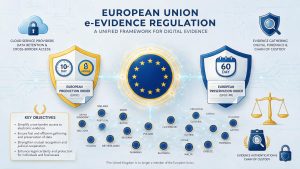
🚨 BREAKING: The EU’s landmark e-Evidence Regulation is now in force — reshaping how cybercrime investigations access digital evidence across borders.
As of 18 August 2026, Regulation (EU) 2023/1543 — the EU Electronic Evidence (e-Evidence) Regulation — is directly applicable across all EU Member States (except Denmark). This is a game-changer for modern criminal investigations, especially in the fight against cybercrime, where speed and cross-border cooperation are critical.
🔍 Main Provisions of the Regulation
The e-Evidence Regulation introduces two powerful, directly enforceable judicial tools:
– European Production Order (EPOC): Allows judicial authorities in one EU country to directly compel a service provider in another Member State to hand over electronic evidence — within 10 days, or just 8 hours in emergency situations.
– European Preservation Order (EPOC-PR): Enables authorities to freeze data for up to 60 days (extendable) to prevent deletion while a production order is prepared.
The regulation covers subscriber data, traffic data, and content data — including emails, chats, IP logs, and more — regardless of where the data is physically stored.
Service providers operating in the EU must designate an EU-based contact point or legal representative to receive and execute these orders — with strict deadlines and significant penalties for non-compliance.
⚖️ Relevance for Law Enforcement & Criminal Justice Authorities
This regulation bypasses the slow, diplomatic Mutual Legal Assistance (MLA) process, enabling direct, rapid access to critical digital evidence held by global tech companies.
For investigators tackling cybercrime, terrorism, fraud, child exploitation, trafficking of migrants and ransomware, this means:
– Faster evidence collection — crucial when data can be deleted in seconds.
– Harmonised rules across the EU — reducing legal fragmentation and procedural delays.
– Stronger enforcement powers — with financial penalties for non-compliant providers.
🌐 Implications for Global Service Providers & Cross-Border Investigations
Global platforms (like Meta, Google, Microsoft, and yes — LinkedIn) now face direct legal obligations under EU law, even if headquartered outside Europe.
This creates both opportunities and challenges:
- ✅ Opportunity: Streamlined cooperation with EU authorities via designated EU representatives.
- ⚠️ Challenge: Conflicting legal obligations (e.g., U.S. Cloud Act vs. EU production orders), data protection compliance (GDPR), and operational readiness to meet 8-hour emergency deadlines.
For criminal investigations, this means more reliable, timely access to evidence — but also greater complexity in navigating jurisdictional conflicts and ensuring fundamental rights are protected.
🎯 Why This Matters for Cybercrime Investigations & Training
Cybercrime doesn’t respect borders — and neither does digital evidence. The e-Evidence Regulation is one of the most significant legal tools ever created to tackle this reality.
But tools are only as good as the people who use them.
Law enforcement agencies across the EU must now urgently invest in continuous, specialized training to ensure investigators, prosecutors, and judges can:
– Correctly issue and execute EPOCs and EPOC-PRs.
– Navigate data categories and legal thresholds.
– Coordinate with service providers and EU enforcement authorities.
– Balance speed with compliance, privacy, and due process.
Without proper training, this powerful regulation risks being underused, misused, or legally challenged.
✅ Recommendation for Law Enforcement Authorities
Prioritize immediate, ongoing, and practical training programs on the e-Evidence Regulation— including mock drills, cross-agency workshops, and collaboration with Eurojust, SIRIUS, CoE and UNODC, as well as national judicial training bodies. Equip national teams not just with legal knowledge, but with operational readiness to act within 8-hour windows when lives or critical evidence are on the line.
#EEvidence #Cybercrime #LawEnforcement #DigitalEvidence #EURegulation #CriminalJustice #EPOC #Eurojust #CrossBorderInvestigations #GDPR #JudicialCooperation